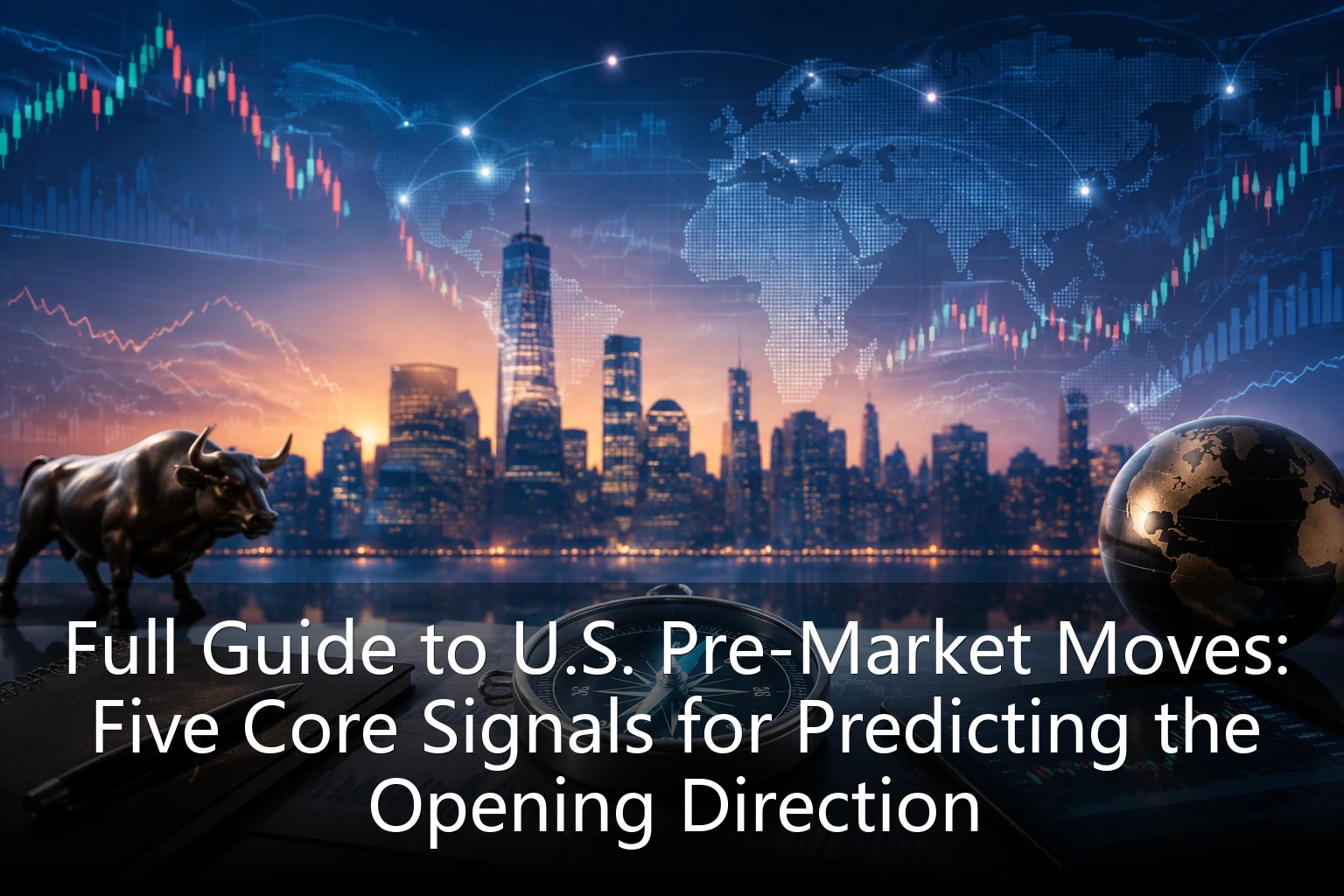
Full Guide to U.S. Pre-Market Moves: Five Core Signals for Predicting the Opening Direction
The U.S. pre-market session refers to the trading window from 4:00 a.m. to 9:30 a.m. Eastern Time, before the regular session opens. Although volume during this window is far lower than in the regular session—typically only about 2% to 5% of the day's total—price action often carries important clues about that day's market sentiment. For short-term traders and active investors, reading pre-market moves is like getting first-hand intelligence before the bell. This article systematically breaks down how to analyze U.S. pre-market activity across four dimensions: the trading mechanism, identification of core signals, influencing factors, and practical strategies.
1. The Basic Framework of the U.S. Pre-Market Mechanism
Pre-market trading is not supported by every broker or trading system; at its core, it relies on ECNs (Electronic Communications Networks) to match orders. Major pre-market platforms include Nasdaq's Pre-Market system and quote services offered by certain market makers. Investors should be aware that pre-market liquidity depth is limited, bid-ask spreads are typically wider, and large orders can easily trigger sharp price swings.
The core participants in pre-market trading include institutional investors, hedge funds, news-driven algorithmic systems, and cross-time-zone international capital. Because participants have varied motivations, pre-market action tends to contain more noise and should not be treated as a simple linear projection of the full-day trend. Understanding this mechanism helps investors maintain realistic expectations when using pre-market signals.
2. Five Core Signals for Predicting the Opening Direction
(1) The Three Major Index Futures
S&P 500 futures, Nasdaq 100 futures, and Dow futures are the most important pre-market bellwethers. These futures contracts trade nearly 24 hours a day, and their price moves directly reflect the market's collective expectation for the opening. Generally, if pre-market futures rise more than 0.3% versus the cash index, it often signals a positive open; a decline of more than 0.5% warrants caution about a lower open. Note that futures often see sharp swings as 9:30 approaches, closely tied to arbitrage traders unwinding positions.
(2) Pre-Market Volume and Unusual Stock Activity
A sudden surge in pre-market volume is another key signal. When a stock's pre-market volume runs several times its average, it usually means major news (earnings, regulatory announcements, breaking news) has triggered institutional repositioning. Investors should focus on the pre-market gainers list and unusual-volume list to quickly identify where the market's attention is. For example, when a tech giant released better-than-expected earnings pre-market in 2024, its stock jumped 8% pre-market, lifting Nasdaq futures and setting the tone for that day's tech strength.
(3) Overnight News and Macro Data
Another core driver of the pre-market session is overnight macro data and corporate announcements. Common factors include Fed officials' speeches, non-farm payrolls, CPI inflation data, retail sales, and large-cap earnings preannouncements or M&A news. Fed-related developments have an especially significant impact on pre-market action because rate-policy expectations are quickly priced into futures and the dollar index, then transmitted to individual stocks. Investors should make it a habit to review the economic calendar before each session and mark key event times.
(4) European Market Correlation
Due to time-zone differences, major European indices (Germany's DAX, the UK's FTSE 100, France's CAC 40) have already closed or are near the close during U.S. pre-market hours. European performance often provides directional cues for U.S. stocks, especially for multinationals and sectors with high global macro exposure (such as energy, materials, and luxury goods). If European markets broadly rise more than 1%, the probability of a higher U.S. open increases notably, and vice versa. This correlation is especially pronounced during major geopolitical events.
(5) Technical Indicators and Key Support/Resistance Levels
Technical analysis also applies in the pre-market, but should be adjusted for overnight futures action. Common tools include the prior day's close, the 5-day moving average, Bollinger Band upper and lower rails, and Fibonacci retracement levels. When pre-market prices break above the prior day's high on expanding volume, it often signals that buyers are in control; conversely, a break below key support with futures weakening in tandem calls for caution against a systemic pullback. Note that thin pre-market liquidity can easily produce false signals, so cross-verification across multiple time frames is recommended.
3. The Deeper Logic Linking After-Hours Action to the Pre-Market
U.S. pre-market action does not exist in isolation; it forms a complete loop with the after-hours session. Earnings releases and major announcements from the after-hours session are digested overnight, and by the next pre-market, their impact has been partially priced in. Understanding this transmission requires grasping two key points: first, the information-decay effect—the same news has a diminishing impact on the market over time; second, the expectation-revision effect—surprises from the after-hours session revise market expectations and are released in concentrated form during the pre-market.
In addition, options-market implied volatility (IV) is a valuable pre-market tool. When a stock's put IV spikes pre-market, it often signals that institutions are hedging downside risk, which may indicate large-scale repositioning. Changes in the put/call ratio are also worth watching, as extreme readings frequently correspond to market turning points.
4. Practical Strategies and Risk Management
Using pre-market moves to guide trading decisions should follow these principles: first, pre-market signals are only an auxiliary reference and cannot replace a complete trading plan; second, thin pre-market liquidity means higher slippage costs, so use limit orders rather than market orders; third, for highly volatile stocks, pre-market risk exposure should be kept to a small share of total position size; fourth, build a pre-market watchlist with key stocks and price levels marked to improve decision efficiency.
For day traders, the core task during the pre-market is to identify the day's leading sector and trading direction, not to rush into positions. The first 15 minutes after the 9:30 open are usually the key window for confirming direction, and pre-market calls need to be validated or revised during that window. A mature pre-market framework should include: macro environment assessment, futures interpretation, screening of unusual stock activity, marking of key support and resistance levels, and preparation of a trade plan.
5. Summary and Outlook
U.S. pre-market action is an important bridge between overnight information and the day's trading, and its analytical value should not be overlooked. By systematically tracking futures, volume anomalies, news flow, European market correlation, and technical indicators, investors can form a basic view on market direction before the bell. However, it must be clearly recognized that the liquidity constraints and information noise of the pre-market session make any judgment inherently uncertain. Maintaining discipline, strictly controlling risk, and reviewing performance against after-hours action are the right path to continuously improving pre-market analysis. As algorithmic trading and AI-assisted decision tools become more widespread, the dimensions of pre-market analysis continue to expand, but the core logic—efficient interpretation of information and strict risk management—remains an investor's most reliable edge.