July Nonfarm Payrolls Shock: US Stocks Hit by Violent Swings at Open
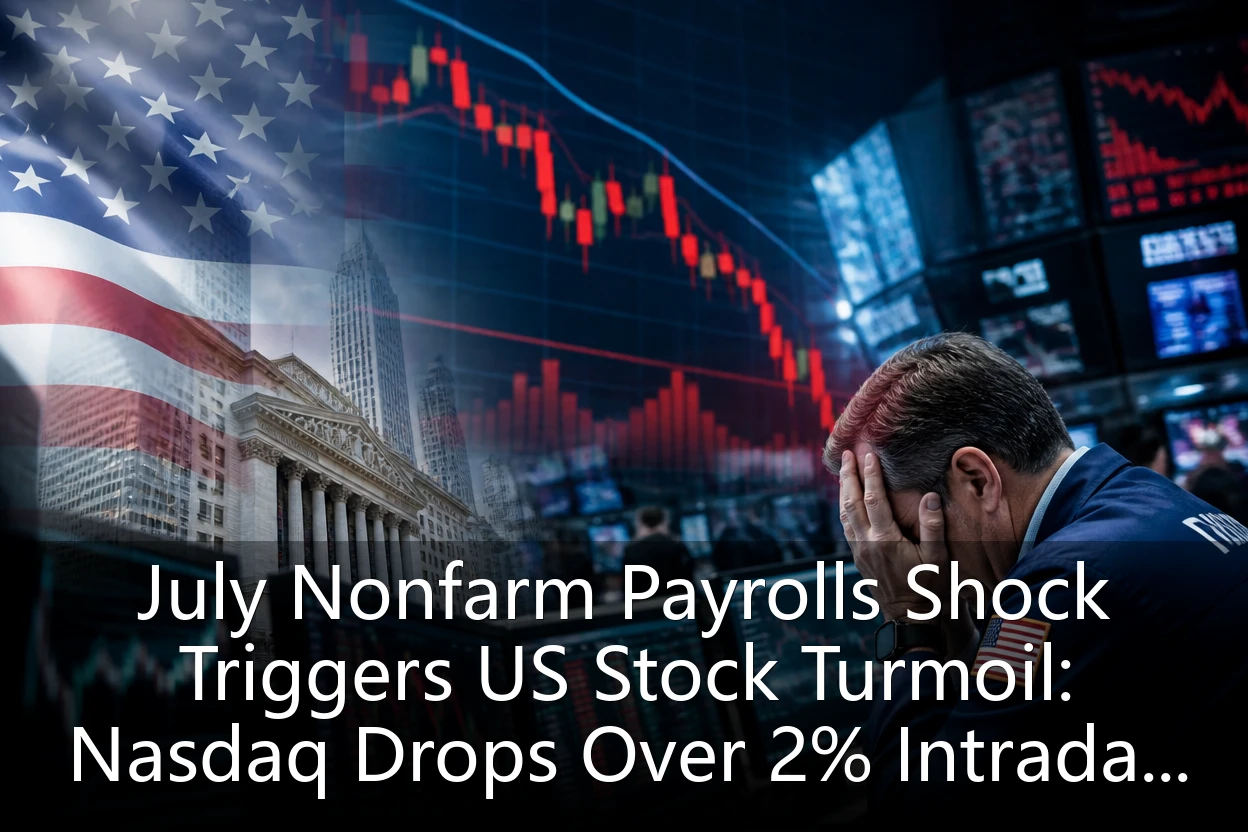
On August 4, 2026, global financial markets once again focused on Wall Street. As the US Bureau of Labor Statistics released the July nonfarm payrolls data, the US stock market immediately experienced violent swings after the opening bell. The data showed that nonfarm payrolls increased by only 85,000 in July, far below the market consensus of 180,000, marking the lowest gain since 2025. Meanwhile, the unemployment rate unexpectedly rose to 4.3%. This shock from a key macroeconomic indicator instantly shattered the market's previous optimism about a "perfect soft landing" for the US economy, directly triggering a collective plunge in the three major US stock indices.
In the real-time US stock market, the Nasdaq Composite Index quickly fell over 2% after the open, with tech stocks bearing the brunt; the S&P 500 Index broke below the 7,100 mark, erasing some gains made since July; the Dow Jones Industrial Average also dropped over 300 points intraday. Corgi Wealth Hub's real-time market tracking system showed that the Volatility Index (VIX) surged over 25% within just one hour after the data release, breaking above its long-term average of 20, indicating that US market sentiment is rapidly shifting from greed to fear.
Rate-Cut Expectations Clash Head-On with Recession Fears
This weak nonfarm payrolls report sparked a battle between two opposing logics in the market, which is the fundamental reason for today's wide intraday swings in US stocks. On one hand, the cooling labor market further strengthened expectations that the Federal Reserve will start a rate-cutting cycle in September. Pricing in the federal funds futures market shows that traders now see a 65% probability of a 50-basis-point cut at the September FOMC meeting, up sharply from 30% before the data release. For the liquidity-dependent US stock market, rate cuts typically mean lower risk-free rates, thereby boosting the valuation center of equity assets, which should be a long-term positive for growth stocks like those on the Nasdaq.
On the other hand, however, the cliff-like drop in nonfarm payrolls also ignited deep-seated investor fears of a hard landing. If the job market deteriorates faster than expected, corporate earnings prospects will inevitably be hit. A senior Wall Street strategist noted: "The market is undergoing a classic 'bad news is bad news' repricing process. At this juncture, investors are no longer simply cheering for rate cuts but are starting to worry whether the cuts themselves signal an irreversible deterioration in economic fundamentals."
Sector Rotation Accelerates: Tech Under Pressure, Defensive Sectors Favored
Amid the violent fluctuations triggered by the nonfarm payrolls data, US stock sector rankings showed clear risk-averse characteristics. Tech stocks led the market decline, with semiconductor and AI concept sectors hit hardest. Heavyweight stocks with huge prior gains, such as Nvidia and Microsoft, saw significant intraday pullbacks. Fund flow data showed that the tech sector recorded over $3 billion in outflows during early trading. High-valuation sectors are often prone to profit-taking sell-offs when facing macro uncertainty.
Meanwhile, traditional defensive sectors saw a massive influx of funds. Utilities, consumer staples, and healthcare sectors performed strongly in today's intraday moves, bucking the trend to move higher. Additionally, the real estate sector, which is highly sensitive to interest rate changes, also gained support from heightened rate-cut expectations. This typical sector rotation phenomenon reflects that, against the backdrop of volatile US market sentiment, funds are accelerating their shift toward safe havens with higher certainty and less sensitivity to economic cycles.
Institutional Interpretation and Post-Market Investment Strategy
- Short-Term Volatility vs. Long-Term Logic: Multiple top investment banks emphasized in pre-market research notes today that a single month's nonfarm payrolls data should not be overly extrapolated. July's data might have been affected by temporary factors like hurricanes. However, a trend of slowing employment is undeniable, and short-term volatility in US stocks will remain elevated.
- Opportunities from a Value Investing Perspective: The Corgi Wealth Hub research team believes that for long-term value investors, systemic pullbacks triggered by macro data often provide quality entry opportunities. In particular, tech leaders with strong free cash flow, deep moats, and valuations that have returned to reasonable ranges still hold significant allocation value after sufficient correction.
- Watch for Subsequent Economic Data Verification: Investors need to closely monitor next week's initial jobless claims and services PMI data to further verify the resilience of the US economy. If subsequent data stabilizes, market sentiment could quickly recover, and the Nasdaq could return to its upward channel.
Conclusion: Seeking Certainty Amid Uncertainty
The July nonfarm payrolls data hit the US stock market like a sledgehammer, waking it from its "Goldilocks economy" dream. In the tug-of-war between rate-cut expectations and recession fears, the volatility of real-time US stock market has significantly amplified. For global investors, the current phase requires both vigilance against short-term pullback risks from overreactions in market sentiment and the agility to capture quality assets unfairly punished during sector rotation. Corgi Wealth Hub will continue to track the latest US stock market developments for you, decoding the investment code behind macroeconomic data, helping you navigate steadily through complex and ever-changing market conditions.