In-depth Analysis of US Stock Market Intraday Trends on September 27, 2026: Tech Stocks Lead Rally, Market Focus on Inflation Data
\nOn September 27, 2026, the US stock market exhibited a typical "V-shaped" recovery, with tech stocks leading the three major indices higher, while market sentiment fluctuated due to concerns about upcoming inflation data. This article will comprehensively analyze the day's intraday trends, explore the underlying driving factors, and provide practical market insights for investors.
\n\nOverall Market Performance: Tech Stocks Lead the Rally
\nThe US stock market opened lower on the day, primarily affected by weak Asian markets the previous night and investor concerns about inflation data. However, as trading progressed, tech stocks gradually gained strength, pushing the three major indices from declines to gains. By the close, the Nasdaq index rose 1.8%, the S&P 500 index gained 1.2%, and the Dow Jones Industrial Average edged up 0.5%.
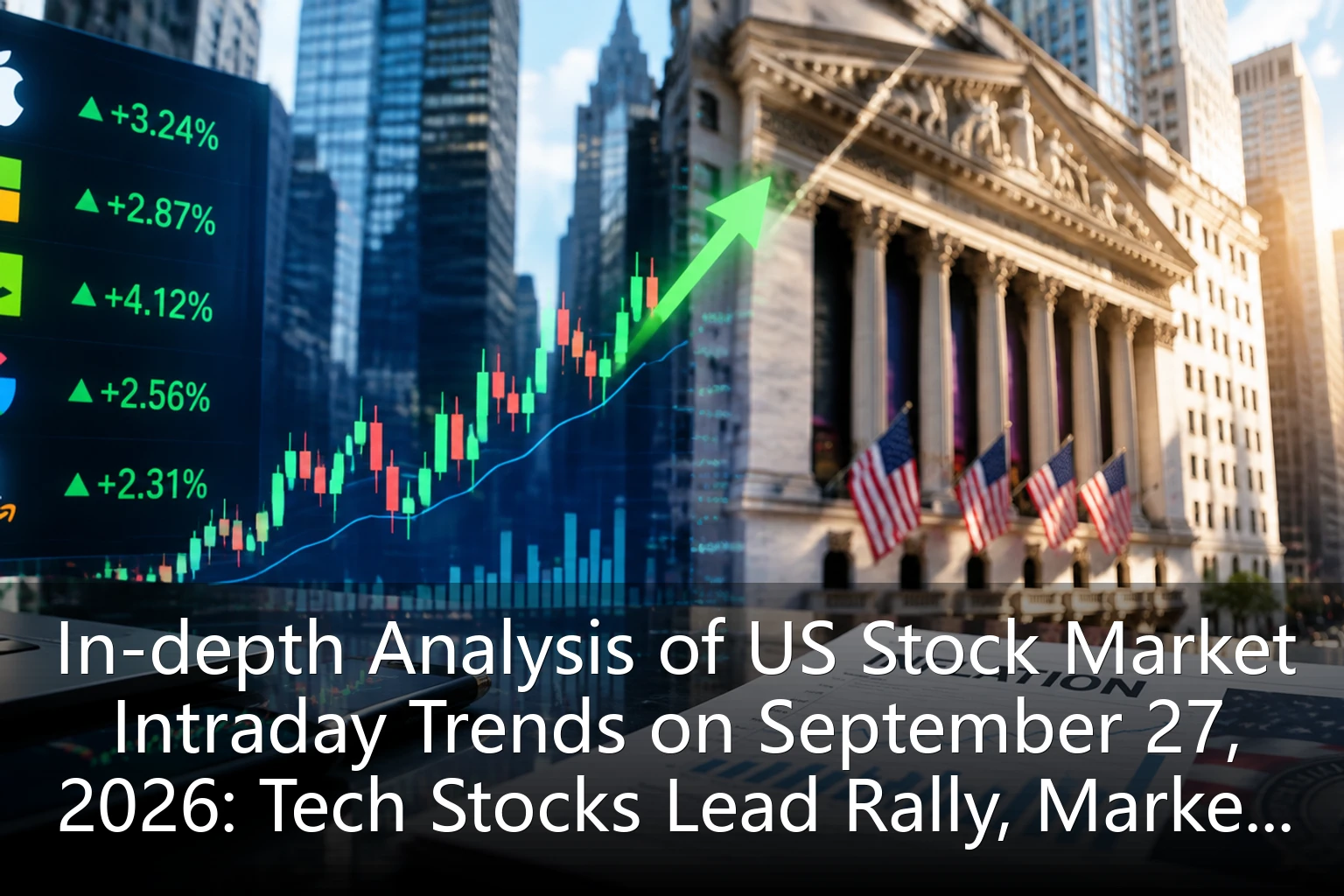
\n\nNotably, tech stocks performed exceptionally well on the day, with tech stock indices represented by the Nasdaq 100 rising more than 2%. Major tech companies like Apple, Microsoft, and Google saw widespread stock price increases, with Apple up 2.3%, Microsoft up 2.1%, and Google up 1.9%. The strong performance of these tech giants became the primary driver of the market rally.
\n\nSector Rotation: Tech and Energy Stocks Lead
\nIn terms of sector performance, tech and energy stocks were the main highlights of the day. The tech sector's rise was mainly driven by AI-related stocks, particularly companies with substantive progress in artificial intelligence. For example, Nvidia's stock price rose 3.2% on the day, becoming a significant contributor to the Nasdaq index's gains.
\n\nThe energy sector also performed strongly, mainly driven by rising international oil prices. As expectations for global economic recovery strengthen, improved market expectations for energy demand have pushed energy stocks higher. Energy giants ExxonMobil and Chevron saw their stock prices rise by 2.1% and 1.8%, respectively.
\n\nIn contrast, the financial sector performed relatively weakly, mainly affected by uncertainty about interest rate policies. Bank stocks generally fell slightly, with JPMorgan down 0.3% and Goldman Sachs down 0.5%.
\n\nKey Influencing Factors: Inflation Data and Federal Reserve Policy
\nOne of the main driving factors of the day's market movements was the upcoming inflation data. Investors closely monitored September's Consumer Price Index (CPI) and Producer Price Index (PPI) data, which will directly impact the Federal Reserve's future monetary policy decisions.
\n\nThe market expects September CPI to rise 3.2% year-on-year, slightly lower than August's 3.4%. If actual data meets or is below expectations, it could enhance market expectations of Fed interest rate cuts this year, thereby boosting the stock market. Conversely, if inflation data exceeds expectations, it could trigger market concerns about the Fed maintaining high interest rates, putting pressure on the stock market.
\n\nAdditionally, recent speeches by Federal Reserve officials have also become a market focus. Several Fed officials have recently spoken about inflation and monetary policy, and their remarks have been interpreted by the market as possible policy shift signals. These speeches have to some extent affected investors' market expectations, thereby influencing stock market trends.
\n\nMarket Sentiment Analysis: Cautious Optimism with Clear Divisions
\nIn terms of market sentiment, investors currently hold a cautiously optimistic attitude toward the US stock market. On one hand, strong corporate earnings, particularly the better-than-expected earnings reports of tech giants, have provided market support; on the other hand, inflationary pressures and uncertainties about interest rate policies still exist, limiting the market's upside potential.
\n\nMarket sentiment indicators show that the VIX (fear index) fell slightly to 16.5 on the day, below the historical average of 20, indicating relatively low market volatility and relatively stable investor sentiment. However, there are clear divisions within the market, with some investors expressing concerns about the high valuations of tech stocks, while others believe that the long-term growth potential of tech stocks remains enormous.
\n\nCapital Flow Analysis: Tech Stocks Receive Favorable Capital Inflows
\nIn terms of capital flows, funds clearly flowed into tech and growth stocks on the day. According to exchange data, the Nasdaq market had net inflows of approximately $12 billion on the day, while the New York Stock Exchange had net outflows of about $3 billion, indicating that capital is shifting from traditional value stocks to tech stocks.
\n\nETF capital flows also reflect this trend. Tech ETFs like QQQ and XLK had net inflows of approximately $2.5 billion and $1.8 billion respectively on the day, while financial ETFs like XLF had net outflows of about $500 million. This change in capital flows indicates that investors are reassessing the investment value of different sectors and are more optimistic about the short-term performance of tech stocks.
\n\nTechnical Analysis: Key Support and Resistance Levels
\nFrom a technical analysis perspective, all three indices tested key support levels during the day. The Nasdaq index found support around 42,000 points before rebounding, the S&P 500 index found support around 4,300 points, and the Dow Jones Industrial Average found support around 34,000 points.
\n\nTechnical indicators suggest that the market may continue to fluctuate within the current range in the short term. The RSI indicator shows the Nasdaq index approaching overbought territory, while the MACD indicator shows that short-term momentum remains upward. This combination of technical indicators suggests that the market may continue to rise in the short term, but attention should be paid to the risk of a pullback.
\n\nProfessional Analyst Views: Divergence and Opportunities Coexist
\nProfessional analysts hold different views on current market trends. Some analysts believe that the tech stock rally may be just a short-term phenomenon, and the market may face adjustments as inflation data is released. They suggest that investors should appropriately reduce their positions in tech stocks during the rally and shift to value stocks with more reasonable valuations.
\n\nOther analysts believe that the long-term growth story of tech stocks remains intact, and the application of emerging technologies like artificial intelligence will continue to provide growth momentum for tech giants. They recommend that investors continue to hold tech stocks, especially those companies with substantive progress in the AI field.
\n\nOverall, analysts generally believe that the current market is at a critical turning point, and investors need to closely follow the upcoming inflation data and Fed policy signals to adjust investment strategies in a timely manner.
\n\nInvestment Strategy Recommendations: Balanced Allocation and Flexible Adjustments
\nBased on current market trends and analyst views, we offer the following investment strategy recommendations for investors:
\n\n- \n
- Balanced Allocation: Investors are advised to maintain a balanced allocation between tech stocks and value stocks, avoiding over-concentration in any single sector. Although tech stocks have performed strongly in the short term, their valuations are already relatively high, while some value stocks have valuation advantages and stable dividend income. \n
- Focus on AI-related Stocks: Artificial intelligence is one of the main driving forces behind the current tech stock rally. Investors can focus on companies with substantive progress in the AI field, especially those that can convert AI technology into actual profits. \n
- Focus on Energy Stocks: As expectations for global economic recovery strengthen, energy demand is expected to improve, and energy stocks may benefit from this. Investors can focus on energy companies with cost advantages and abundant reserves. \n
- Focus on Interest Rate-sensitive Stocks: If inflation data meets expectations, the Fed may cut interest rates this year, which will benefit interest rate-sensitive stocks such as real estate and utilities. Investors can appropriately allocate to these types of stocks. \n
- Stay Flexible: The market may continue to fluctuate in the short term, and investors need to remain flexible, adjusting their portfolios promptly according to market changes. Especially after the release of inflation data and Fed policy signals, the market may experience significant fluctuations, and investors need to be prepared to respond. \n
Outlook: Focus on Key Data and Policy Signals
\nLooking ahead, the US stock market will face several key factors: first, the upcoming inflation data, which will directly affect market expectations of Federal Reserve monetary policy; second, the performance of the earnings season, especially the earnings reports of tech giants; and finally, geopolitical risks, including China-US relations, the Russia-Ukraine conflict, etc.
\n\nIn the long run, the US stock market still has appeal. The US economy has a solid foundation, strong corporate profitability, and continuous technological innovation, all of which will provide support for the US stock market. However, in the short term, the market may face inflationary pressures and uncertainties about interest rate policies, and investors need to be prepared to deal with fluctuations.
\n\nOverall, the US stock market performance on September 27, 2026 reflects the complexity and uncertainty of the current market. The strong performance of tech stocks has provided market support, but uncertainties about inflation data and Federal Reserve policy still exist. Investors need to closely follow these key factors, flexibly adjust investment strategies, and respond to market changes.
\n\nFor long-term investors, current market volatility may provide opportunities to buy quality stocks, especially those companies with strong competitive advantages and stable growth potential. For short-term traders, it is necessary to closely follow changes in market sentiment and capital flows, and flexibly adjust trading strategies.
\n\nRegardless of investment style, investors need to remain rational, avoid being influenced by market sentiment, and adhere to investment philosophies based on fundamentals and long-term value. Only in this way can long-term investment goals be achieved in a complex and ever-changing market environment.